The blueprint for secure AI operations.
Unified governance, real-time observability, and automated policy enforcement. NiyamR AI provides the technical guardrails your enterprise needs to deploy AI with absolute confidence.
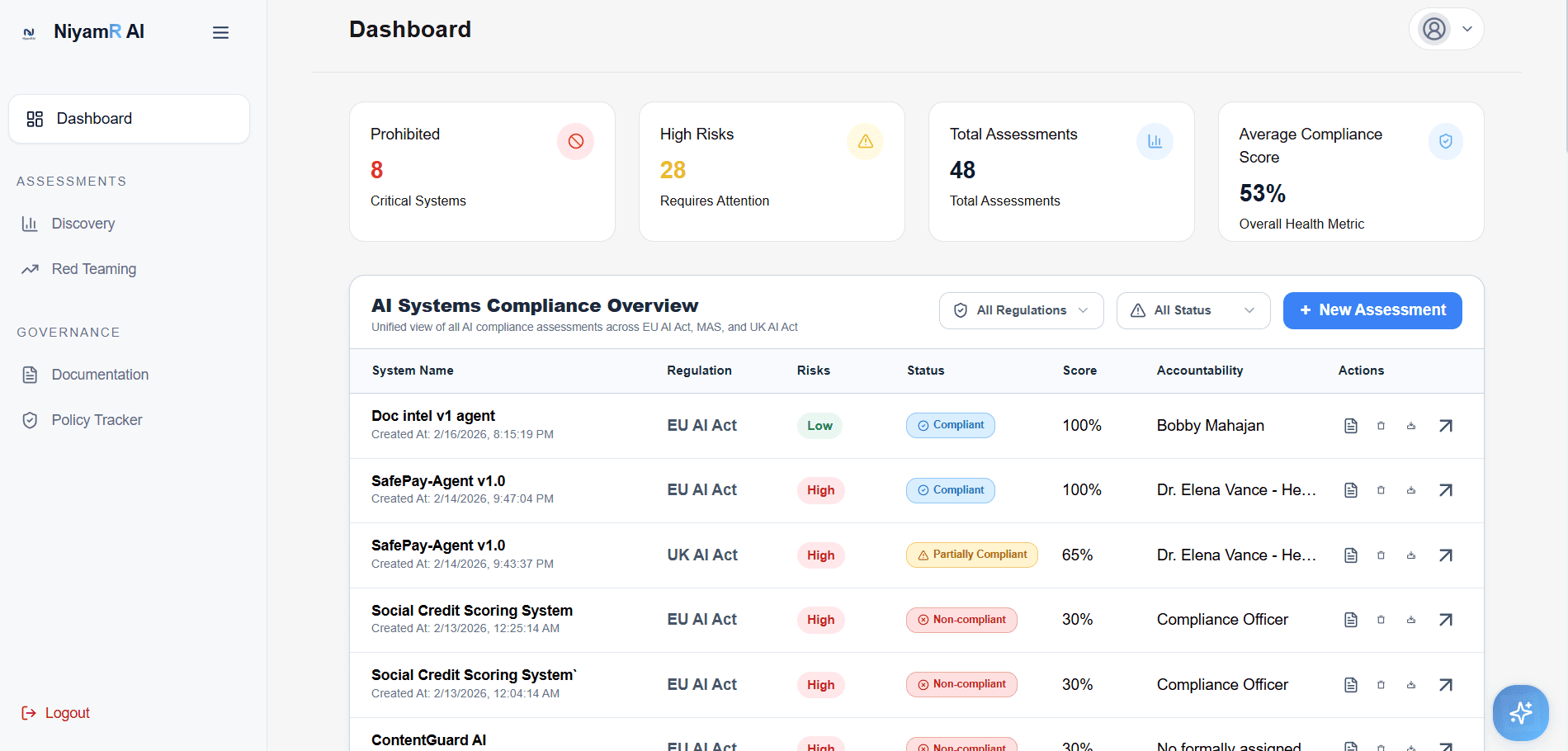
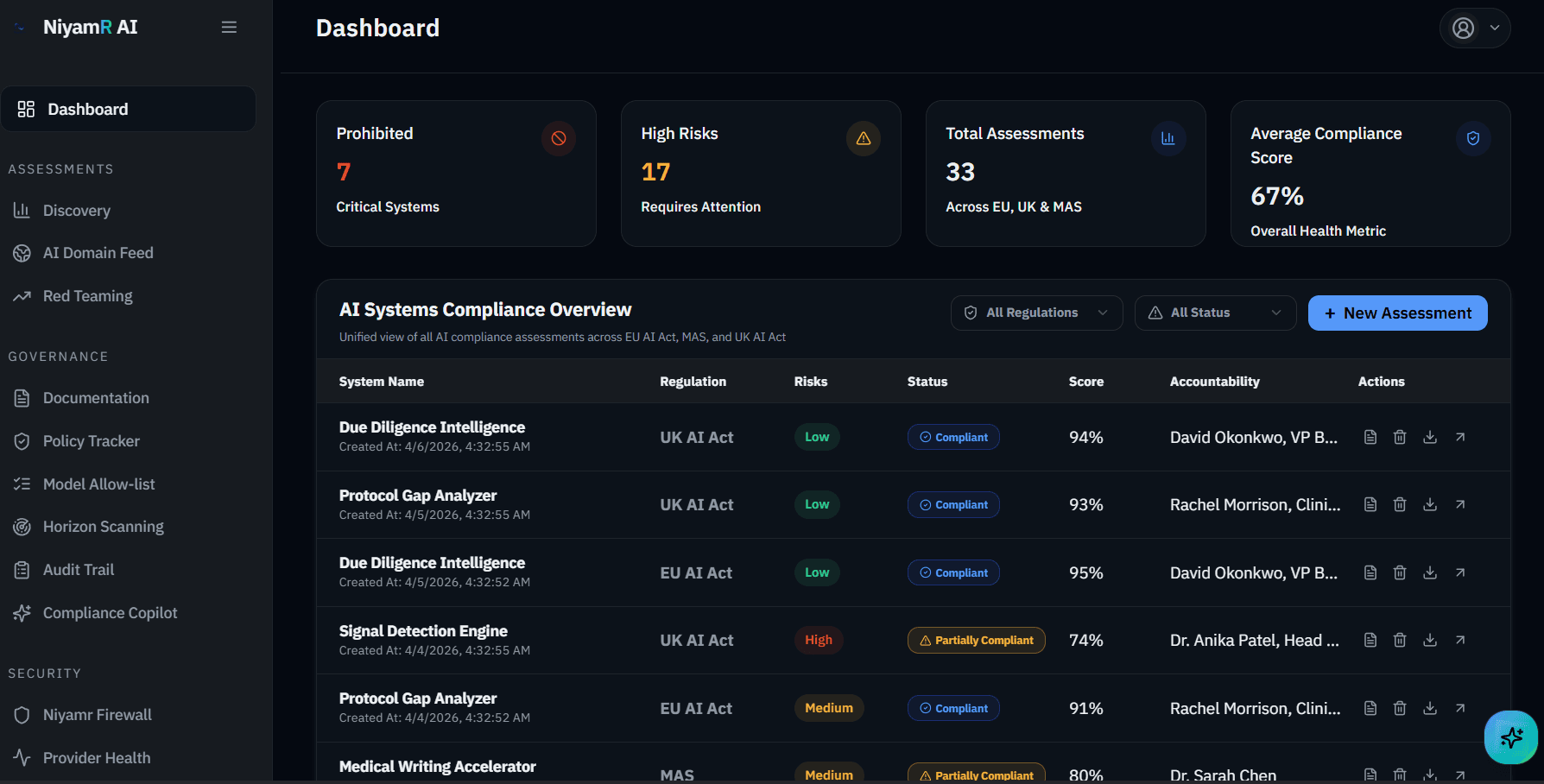
Everything we do, on one real prompt.
One support ticket with a name, an email and a card number in it. Scan it, then walk it through the platform. Every control here is live.
Summarise this ticket: [PERSON], [EMAIL], card [CARD], complaining about a double charge.
Find the AI already in use.
Most of it was never registered. Your gateway, the browser agent, and your firewall's domain feed each report what they see. Jane's summariser is in this list. So is the ChatGPT account 41 people are pasting tickets into.
Nobody can name every AI system in the company. It arrives through a browser tab and a corporate card, and never touches a registry.
Where it stops · On the network we see a destination, not a prompt. Names need the browser agent or your identity provider.
Measure it against the regulation.
It's a deployed high-risk system, so Article 26 applies. Controls are answered from system data, not a questionnaire. Open a failing one to see the obligation and the task it creates.
Your compliance answers live in a spreadsheet that was true the day someone filled it in. The system changed; the answers didn't.
Where it stops · An assessment is a finding, not a legal opinion. Your counsel signs off.
A deployer of a high-risk AI system must use it in line with the provider’s instructions, assign human oversight to people with the competence and authority to exercise it, and keep the automatically generated logs.
Art. 26(1)–(6) · summarisedWrite the policy yourself.
Rules down the side, systems across the top. Every cell is log, redact, or block. That is the whole configuration. The row your prompt actually triggers is marked, and that is the one the next step enforces.
A policy in a PDF enforces nothing. Until it is a configuration, every team reads it differently and no system reads it at all.
Where it stops · In a real rollout every rule starts on log until you've seen your own traffic.
Enforce it where the prompt is.
Three places to stand: your own application, the employee's browser, or the network edge. Each runs Jane's ticket under the policy you just set.
By the time a prompt is a problem it has already left the building. A rule only works where the prompt actually passes.
Where it stops · The network can allow or deny a destination. It can't read a prompt, so it can't redact.
Summarise this ticket: [PERSON], [EMAIL], card [CARD], complaining about a double charge.
The model answers from the text above. A placeholder stays a placeholder, so the reply can refer to [CARD] without the value ever having been sent.
The personal name, the email and the card number are replaced before the request leaves your perimeter. The model still has enough to do the job, and your agent gets an answer.
Redaction changes the prompt. Where a task genuinely needs the raw value, the rule has to be block or an approved exception.
Keep the receipt.
What just happened to Jane's ticket is a ledger row, tied to the obligation it answers. Auditors read this, not your slides.
An auditor asks what happened on 14 August. Screenshots, Slack threads and someone's memory are not an answer.
Where it stops · The pack records what we saw and did. It does not certify you compliant.
Every block is a receipt.
Comprehensive Control Plane
for Enterprise AI.
NiyamR AI consolidates security, compliance, and discovery into a single, technical source of truth for your entire AI ecosystem.
Automated RAG-based Compliance Assessment
Ground your assessments in actual regulations. Our RAG engine cross-references your system data against GDPR, EU AI Act, and NIST RMF in real time.
- Real-time Regulation Cross-Referencing
- Automated Gap Analysis
- Evidence Collection Automation
- Multi-Jurisdictional Support
- Frameworks
- GDPR · EU AI Act · NIST RMF
- Output
- Gap analysis with citations
- Evidence
- Collected as you go
Ready to institutionalize AI safety?
Start with the registry. Every rule runs in monitor mode on your own hardware until you have seen your own traffic and decided what to turn up.